
How to plan a home solar installation in West Bengal: a practical checklist and cost guide
A definitive, step-by-step homeowner manual. Learn how to verify your roof’s solar potential, compare on-grid and hybrid architectures, claim the full ₹78,000 PM Surya Ghar DBT subsidy, and achieve complete electricity bill freedom in West Bengal.
Sunray Power Technical EPC Team
PM Surya Ghar Empaneled Vendor • Tamluk, West Bengal
Updated September 2026
9 min comprehensive read
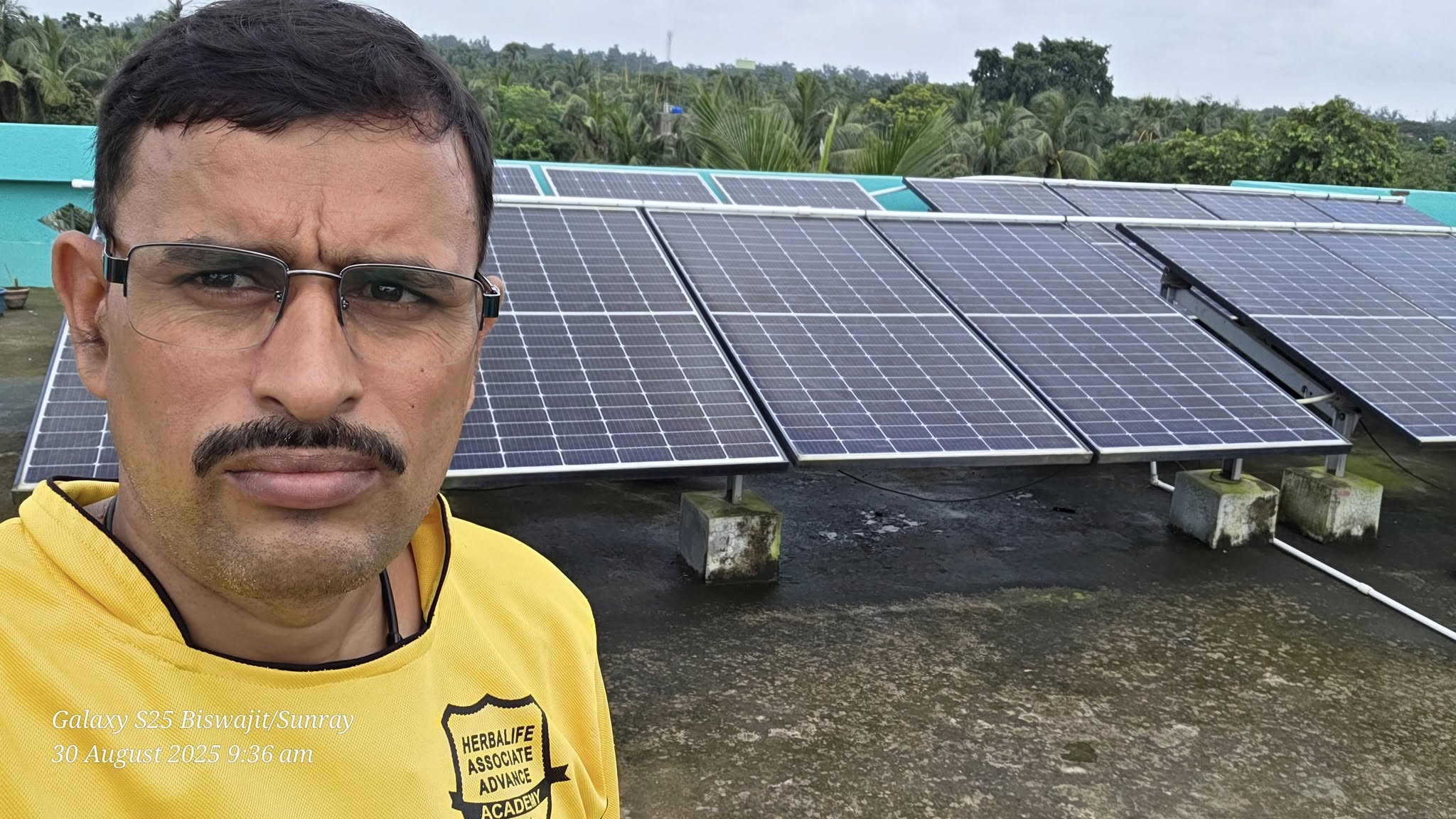
A 3.3 kW Net-Metered On-Grid Solar Rooftop System installed by Sunray Power Energy in South Bengal with elevated galvanized structure.
Executive Summary: What Every Bengal Homeowner Must Know
₹78,000 Maximum Direct Subsidy: Central DBT credit deposited directly into your Aadhaar-linked bank account for 3 kW and higher rooftop systems.
Rapid 3.2 to 3.7 Year Payback: With WBSEDCL / CESC residential power tariffs at ₹7.50–₹8.90 per unit, solar yields 25%+ tax-free annual ROI.
Space Requirement: Only ~100 sq. ft. of shadow-free south-facing roof area is needed per kilowatt (300 sq. ft. for a standard 3 kW plant).
Turnkey Local Execution: Sunray Power Energy handles all DISCOM net-metering liaison, portal registration, structural fabrication, and commissioning.
Article Table of Contents
1. Assessing Roof Suitability for Solar in West Bengal →
2. On-Grid vs. Hybrid: Which System Is Best for You? →
3. Realistic Cost Breakdown & Long-Term Bill Savings →
4. Simple Payback Example for a 1–3 BHK Household →
5. How to Claim PM Surya Ghar Subsidy & Net-Metering →
6. Practical Checklists (Survey, Documents, Timelines) →
7. Real-Life Case Study: The Das Family in Tamluk →
8. Solar Panel Maintenance & Longevity Tips →
9. Why Sunray Power Energy Is Your Trusted Partner →
10. Frequently Asked Questions (FAQ) →
1. Assessing Roof Suitability for Solar in West Bengal
Before investing in solar panels, evaluating your rooftop’s structural capacity and solar exposure is essential. West Bengal is situated at approximately 22.5° North latitude, which means solar panels tilted toward the True South capture maximum solar irradiation throughout all four seasons.
Direction & Optimal Tilt
Panels must face True South (Azimuth 180°) at a 20° to 23° fixed tilt. This angle maximizes harvest during the high-sun summer months while still shedding heavy monsoon rain effectively.
Shadow-Free Area Rule
Budget 100 sq. ft. of unobstructed area per 1 kW. Overhead water tanks, parapet walls, staircase mumty rooms, and neighboring trees must not cast shade between 9:00 AM and 4:00 PM.
Cyclone Wind Load Resilience
Due to coastal storms in Bengal (like Remal and Amphan), structural mounting MUST use Hot-Dip Galvanized (HDG) steel (80+ microns) or structural anodized aluminum rated for 170 km/h gusts.
Want to keep using your rooftop terrace? Ask for an Elevated GI Structure!
Many homeowners in Bengal worry about losing their rooftop for evening strolls, winter sunbathing, or drying clothes. Sunray Power Energy specializes in custom 6-ft to 8-ft elevated pergola-style solar canopies. The panels form a sturdy waterproof shade canopy overhead while leaving 100% of your rooftop terrace fully walkable and usable beneath.
2. On-Grid vs. Hybrid Solar Systems: Which is Right for You?
One of the first major decisions a homeowner faces is choosing between a Grid-Tied (On-Grid) system and a Hybrid (Solar + Battery Storage) system. While both reduce your electricity bills, their operating principles and financial payback profiles differ significantly.
| Evaluation Criteria | On-Grid Solar System (Recommended) | Hybrid Solar System |
|---|---|---|
| Capital Investment | Lowest (Fastest payback) | Moderate to High (+ battery cost) |
| Battery Requirement | None (Grid acts as infinite virtual battery) | Requires Solar/LiFePO4 Battery Bank |
| Power During Grid Blackout | Shuts off for lineman safety (Anti-Islanding) | Instant battery backup (<15ms switchover) |
| Net-Metering Support | Yes (Full import/export credits) | Yes (Charges battery first, then exports) |
| PM Surya Ghar Subsidy | Full Central DBT (Up to ₹78,000) | Eligible for Solar PV portion with DCR panels |
| Typical Payback Period | 3.2 to 4.0 Years | 5.5 to 7.0 Years |
| Best Suited For | Urban/Semi-Urban homes with stable grid | Areas with frequent load shedding & power cuts |
Why 85% of Bengal Homeowners Choose On-Grid
If you live in an urban or suburban area under WBSEDCL or CESC where daily blackouts are minimal, an On-Grid system provides the absolute fastest return on investment (3.2 to 3.8 years). The grid functions as an infinite virtual battery, eliminating battery maintenance and recurring battery replacement costs every 5–7 years.
When Does a Hybrid System Make Sense?
If your locality experiences frequent summer load shedding or low voltage, a Hybrid system equipped with Lithium Ferro-Phosphate (LiFePO4) batteries provides uninterrupted power for essential loads (fans, lights, Wi-Fi, medical devices, refrigerators) during outages while still exporting excess energy through net-metering.
3. Estimated Upfront Costs vs. Long-Term Bill Savings
Under the landmark PM Surya Ghar: Muft Bijli Yojana, central financial assistance (CFA) is disbursed directly into the homeowner’s bank account via Direct Benefit Transfer (DBT). Here is the comprehensive turnkey cost and savings breakdown for residential rooftop systems in West Bengal:
| System Capacity | Required Area | Average Gross Cost | Central DBT Subsidy | Net Out-of-Pocket | Est. Annual Savings | Simple Payback |
|---|---|---|---|---|---|---|
| 1 kW System | ~100 sq. ft. | ₹65,000 - ₹75,000 | ₹30,000 | ₹35,000 - ₹45,000 | ₹10,500 - ₹12,000 | 3.3 - 3.8 Years |
| 2 kW System | ~200 sq. ft. | ₹1,25,000 - ₹1,40,000 | ₹60,000 | ₹65,000 - ₹80,000 | ₹21,000 - ₹24,000 | 3.1 - 3.5 Years |
| 3 kW (Most Popular) | ~300 sq. ft. | ₹1,85,000 - ₹2,05,000 | ₹78,000 (Max) | ₹1,07,000 - ₹1,27,000 | ₹32,000 - ₹36,000 | 3.2 - 3.7 Years |
| 4 kW System | ~400 sq. ft. | ₹2,40,000 - ₹2,65,000 | ₹78,000 (Capped) | ₹1,62,000 - ₹1,87,000 | ₹43,000 - ₹48,000 | 3.8 - 4.2 Years |
| 5 kW System | ~500 sq. ft. | ₹2,95,000 - ₹3,25,000 | ₹78,000 (Capped) | ₹2,17,000 - ₹2,47,000 | ₹55,000 - ₹62,000 | 3.9 - 4.3 Years |
* Gross costs include Tier-1 DCR solar modules, BIS on-grid string inverter, hot-dip galvanized mounting structure, dual-pole AC/DC surge protection devices (SPD), earthing kits with copper-bonded rods, AC/DC DB boxes, cable conduits, installation labor, WBSEDCL/CESC net-meter testing coordination, and GST.
Critical Rule: Ensure Your Installer Uses 100% DCR Modules for the ₹78,000 Subsidy
Under the Ministry of New & Renewable Energy (MNRE) guidelines, Domestic Content Requirement (DCR) solar panels — where both the solar cells and modules are manufactured in India — are strictly mandatory for claiming the PM Surya Ghar subsidy. Installing non-DCR imported panels will cause the portal to reject your subsidy claim immediately. Sunray Power Energy installs only certified Tier-1 DCR modules with verified portal QR codes.
4. Simple Payback Example for a Typical 1–3 BHK Household
To see how rooftop solar translates into tangible bank savings, let us simulate a real-world scenario of an independent 3-BHK home in West Bengal connected to WBSEDCL with an average monthly electricity bill of ₹2,800 to ₹3,200.
Homeowner Baseline
340 Units / Month
2 Inverter ACs, 1 Refrigerator, TV, Fans, Lights & 1HP Water Pump.
Pre-Solar Bill: ~₹2,850/month (₹34,200/year)
Recommended System
3.3 kW On-Grid System
6 x 550W Tier-1 DCR Mono PERC Panels + 3.3 kW String Inverter.
Generates ~380–400 Units / Month
Post-Solar Outcome
Electric Bill Slashed ~95%
Homeowner only pays nominal fixed meter rent (~₹100–₹140/mo).
Annual Savings: ~₹32,800/year
The Financial Return Math:
Gross Turnkey Project Cost (3.3 kW DCR System with installation & net meter):
₹1,95,000
PM Surya Ghar Central DBT Subsidy (Credited directly to bank):
- ₹78,000
Actual Net Out-of-Pocket Investment:
₹1,17,000
Net Annual Electricity Bill Reduction:
~₹32,800 / year
Break-Even / Simple Payback Period:
3.57 Years!25-Year Long Term Wealth Creation: Once your system reaches the 3.5-year break-even mark, the remaining 21.5+ years of power generation are virtually 100% pure financial profit. Over 25 years, factoring modest 3% annual utility tariff inflation, this 3.3 kW system will yield over ₹8,20,000 in cumulative electric bill savings!
5. Step-by-Step Guide: How to Claim PM Surya Ghar Subsidy & WB Net-Metering
Many homeowners get anxious about government red tape and DISCOM approvals. When you partner with an empaneled EPC installer like Sunray Power Energy, our team manages 100% of the paperwork, documentation, and on-ground utility liaison for you:
01
PreparationSite Feasibility & Consumer ID Check
Verify roof shadow orientation and ensure your WBSEDCL (9-digit Consumer ID) or CESC (11-digit Customer ID) bill matches the property owner’s Aadhaar details.
02
Online ApplicationNational Portal Registration
Register on the central PM Surya Ghar portal (pmsuryaghar.gov.in) with your electricity account number and mobile number linked to Aadhaar.
03
Vendor SelectionChoose Registered Vendor: Sunray Power Energy
Select Sunray Power Energy as your official empaneled vendor. We submit the single-line diagram (SLD) and technical feasibility request to your DISCOM.
04
EPC ExecutionDCR Solar Installation & Safety Earthing
Our certified engineering team installs ALMM-listed DCR Mono PERC/TopCon modules, hot-dip galvanized mounting structures, chemical earthing pits, and lightning arrestors.
05
CommissioningDISCOM Inspection & Bi-Directional Net-Meter
WBSEDCL/CESC engineers inspect the site, conduct anti-islanding tests, and replace your traditional meter with a smart bi-directional net-meter.
06
Disbursement₹78,000 DBT Subsidy Direct to Bank
We upload the signed commissioning certificate and net-meter photo to the National Portal. The central government releases the DBT subsidy directly into your bank account within 30 days.
6. Practical Checklists for Homeowners
Keep these three quick checklists handy to ensure a smooth, zero-delay installation experience:
A. Pre-Installation Survey Checklist
Roof orientation confirmed South / South-West
Shadow-free test: 9:00 AM to 4:00 PM clear sun
RCC parapet height & staircase shading factored
Shortest cable route to main distribution box mapped
Dedicated garden/ground space for 3 earthing pits
B. Required Documents Checklist
Latest paid electricity bill (WBSEDCL or CESC)
Homeowner Aadhaar Card (Linked to active mobile)
Homeowner PAN Card
Cancelled bank cheque / passbook with name printed
Roof ownership document / Latest Municipal Tax Receipt
C. Realistic Timelines Checklist
Day 1–2: Free doorstep roof survey & 3D layout
Day 3–5: Portal registration & DISCOM application
Day 7–15: DISCOM technical feasibility sanction
Day 16–18: Complete structural & electrical installation
Day 20–30: Net-meter installation & commissioning
Day 40–55: ₹78,000 DBT credited to your bank account
7. Real-Life Case Study: The Das Family in Tamluk (Purba Medinipur)
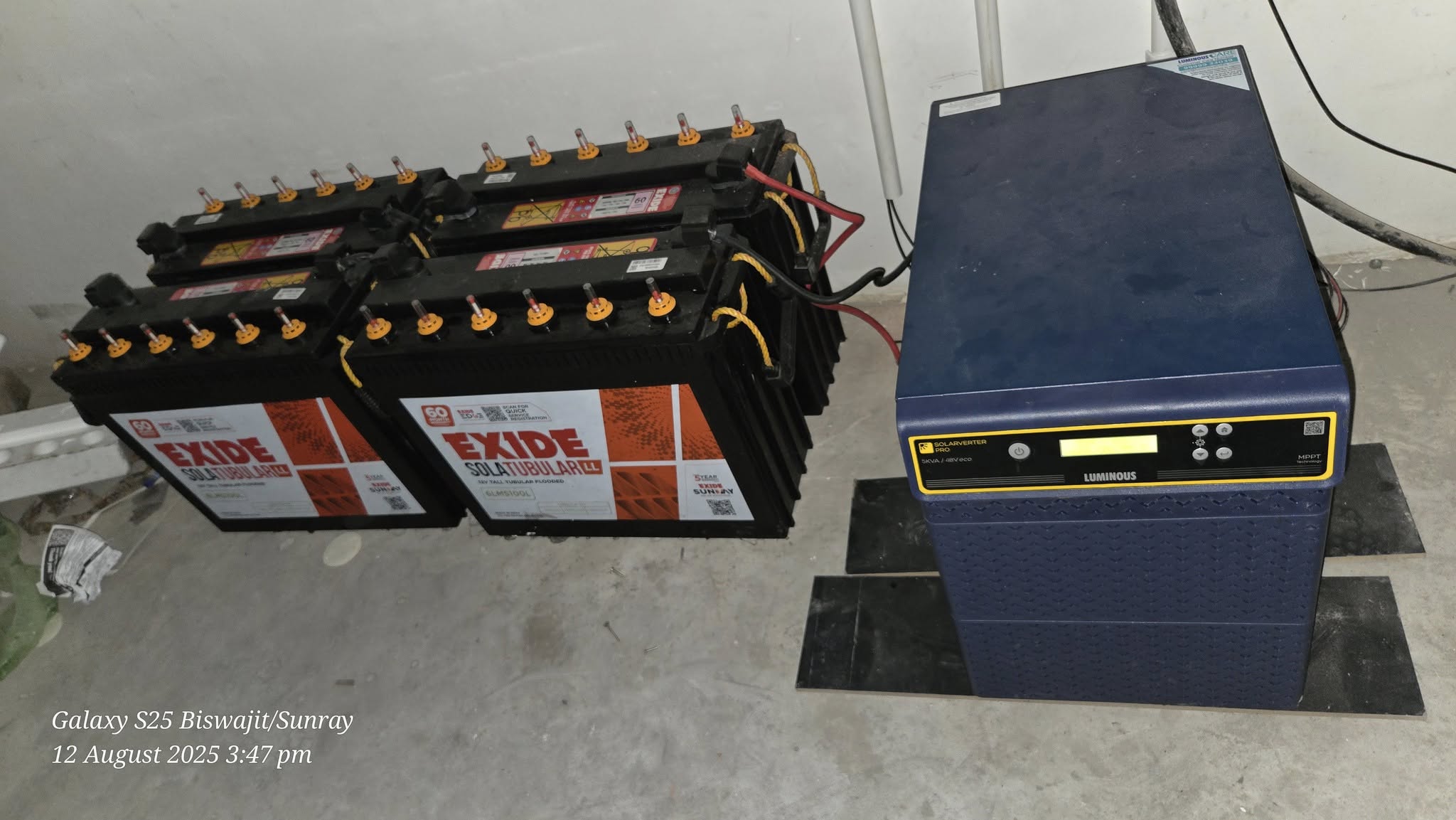
How a 3.3 kW System Wiped Out a ₹3,600/Month Summer Electricity Bill
Mr. Subhendu Das, a retired government officer residing in Padumbasan, Tamluk, was struggling with rising quarterly electricity bills exceeding ₹10,500 during peak summer months due to heavy air-conditioner usage across two bedrooms.
System Installed: 3.3 kW On-Grid (6 x 550W DCR Modules)
Mounting Type: 7-foot Elevated GI Gazebo Pergola
Gross Project Cost: ₹1,95,000
DBT Subsidy Received: ₹78,000 (Credited in 24 days)
Net Investment: ₹1,17,000
New Electricity Bill: ₹115 / month (Fixed meter rent)
“Sunray Power Energy took care of everything from portal registration to WBSEDCL meter testing. The 7-foot elevated structure gave us a wonderful shaded terrace for our evening tea, and seeing our electricity bill drop from ₹3,600 to barely ₹115 has been incredible.” — Mr. S. Das, Homeowner
8. Solar Panel Maintenance & Longevity Tips for Bengal’s Climate
Solar panels have no moving parts and require minimal intervention. However, West Bengal’s climate presents high ambient humidity, dry dusty winter winds, and intense monsoon seasons. Follow these rules to keep your plant generating at 95%+ peak efficiency:
RULE 1
Clean Early Morning
Always clean panels between 6:00 AM and 8:30 AM. Never spray cool water on sun-heated panels at midday; the sudden thermal shock can cause microscopic solar cell fractures.
RULE 2
Use Soft Sponge & Water
Use low-pressure soft tap water and a soft microfibre wiper. Never use harsh acid, chemical detergents, or abrasive wire brushes that can scratch the anti-reflective glass coating.
RULE 3
15-Day Cleaning Interval
In dry dusty months (November to April), rinse panels every 14 to 20 days. Heavy soiling can drop generation by 10–18%. Monsoon rains naturally self-clean the panels.
RULE 4
Annual Electrical Audit
Have Sunray engineers inspect your earthing pit resistance (<5 ohms), lightning arrestor continuity, and inverter error logs once a year before the cyclone season.
9. Sunray Power Energy: Your Trusted Turnkey Solar Partner in West Bengal
Established in 2009 in Tamluk, Sunray Power Energy is not an aggregator or a distant sales call center. We are an authorized, empaneled PM Surya Ghar turnkey EPC provider with our own fabrication workshops, in-house certified electrical engineers, and deep relationships with WBSEDCL and CESC distribution divisions.
PM Surya Ghar Empaneled
Direct vendor registration guaranteeing smooth ₹78,000 subsidy approval on the National Portal.
Full DISCOM Liaison
Zero hassle for you: we handle feasibility approvals, meter testing, and sync certificates with WBSEDCL & CESC.
Tier-1 DCR Hardware
Only BIS & ALMM approved TopCon/Mono PERC modules with 25-year linear generation warranties.
Free Doorstep Survey
Zero obligation 3D shade analysis and precise cost/payback calculation right at your home.
10. Common Questions About Home Solar in West Bengal
How much subsidy does PM Surya Ghar provide for residential solar in West Bengal?
Under the PM Surya Ghar: Muft Bijli Yojana, homeowners receive direct central DBT subsidies: ₹30,000 for a 1 kW system, ₹60,000 for a 2 kW system, and a maximum of ₹78,000 for a 3 kW or higher capacity system. The subsidy is directly deposited into your bank account within 30 days of net-meter commissioning.
Can a 3 kW rooftop solar system run 1.5-ton ACs in West Bengal summers?
Yes. An on-grid 3 kW solar system generates approximately 12–14 units of electricity per day in sunny weather. Because the system is synchronized with the utility grid (WBSEDCL or CESC), you can run high-load appliances like 1.5-ton inverter ACs, refrigerators, water pumps, and washing machines seamlessly. Any shortfall is drawn from the grid automatically, and any surplus generated is fed back for billing credits.
What happens to solar generation during cloudy monsoon days in West Bengal?
Modern Tier-1 Monocrystalline PERC and TopCon solar modules continue to generate electricity even under overcast skies using diffused sunlight, typically operating at 25% to 40% of their peak capacity. With net-metering, the excess units your system exports during sunny pre-monsoon months are banked with WBSEDCL/CESC to offset rainy days.
How does WBSEDCL net-metering billing work?
WBSEDCL installs a bi-directional smart meter that tracks both import (electricity consumed from the grid) and export (excess solar power sent into the grid). On your quarterly or monthly bill, you only pay for Net Energy = (Imported Units – Exported Units). If export exceeds import, the surplus units roll over to subsequent billing cycles.
What is the required roof area for a 3 kW residential solar system?
As a rule of thumb, you need approximately 100 square feet of shadow-free roof area per kilowatt. For a standard 3 kW system (consisting of 6 high-efficiency 550W panels), you need approximately 280 to 320 square feet of clear, unshaded south-facing rooftop space.
How long does the entire solar installation process take from survey to subsidy disbursement?
With Sunray Power Energy handling the turnkey process, the typical timeline is 30 to 45 days. Site survey takes 1-2 days, National Portal and DISCOM technical feasibility takes 7-15 days, physical installation takes 2 days, DISCOM net-meter inspection takes 10-15 days, and the ₹78,000 central DBT subsidy arrives in your bank account within 20-30 days of commissioning.
Ready to Plan Your Rooftop Solar Installation?
Stop paying high quarterly electricity bills to WBSEDCL or CESC. Schedule your free rooftop shadow assessment today, lock in your ₹78,000 PM Surya Ghar subsidy, and enjoy 25 years of clean, free power.
Bahir Agar, Ramtarak Hat, Tamluk, Purba Medinipur, WB - 721151
•
+91 99329 23931